
Minesweepers: The World’s Toughest Job on the Navy’s Smallest Ships
Anchors Away, Haze Grey and Underway — Welcome to the South Texas Minesweeping Fleet.

If you’ve ever served in the Navy — and especially if you’ve had the privilege (or punishment, depending on the day) of serving on one of the most challenging platforms the Navy ever floated — the Avenger‑class Mine Countermeasures ships, the mighty MCMs — then you already know where this story is headed.
If not, pour yourself a fresh cup of Joe and enjoy a tour through the modern McHale’s Navy.
Picture this: a Minesweeper is 224 feet long, 38 feet wide, and draws about 17 feet of navigational draft, though the actual draft is closer to 12 feet. And yes — it’s made of Douglas fir and fiberglass. That’s right. Wooden ships. One of the sayings, “Wooden Ships and Iron Men,” and on an MCM, you learned real quick which one you were supposed to be.

For comparison, an Arleigh Burke destroyer is 508 feet long, 66 feet wide, and draws 31 feet. So yes, the MCM is basically the dinghy tied up behind it.
We had racks (beds) for 84 sailors — all men back then, because the ships weren’t built with facilities for women. But, being the Navy, we often had more than 84 bodies assigned. Creativity became a survival skill. Some ships converted the forward crew lounge into a makeshift berthing (a compartment where multiple people slept/lived). Others dragged out cots that probably last saw action in Vietnam. At one point during my time on a Minesweeper, we mustered 101 sailors. It was crowded enough to qualify as a social experiment, but at least I didn’t have to hot‑rack (Rotate turns sleeping in the same bed) or sleep in a corner of After Steering.
Reporting Aboard — and Immediately Smashing My Head
I won’t bore you with the details of transferring, training, and all the administrative nonsense before reporting to my first ship, USS Warrior (MCM‑10), homeported in Ingleside, Texas.
What I will tell you is that my very first thought after stepping aboard was:
“I’d better remember to duck next time.”
I had just smashed my head into the overhead breezeway on the port side, just aft of the Quarterdeck. That would become a recurring theme. I hit my head so often that a few years later, our Doc — asked me, deadpan, “Where’s your baseball helmet?”
But I learned quickly that succeeding on that ship wasn’t complicated.
Do what you’re told.
Have a positive attitude.
And when you get froggy, do a little extra.
Simple.
What wasn’t simple was the qualification culture. You couldn’t eat like a normal human until you completed your basic Maintenance, Damage Control, and Watch standing qualifications. You couldn’t face the TV during meals, couldn’t watch a movie after hours, couldn’t do much of anything until you proved you weren’t a liability.
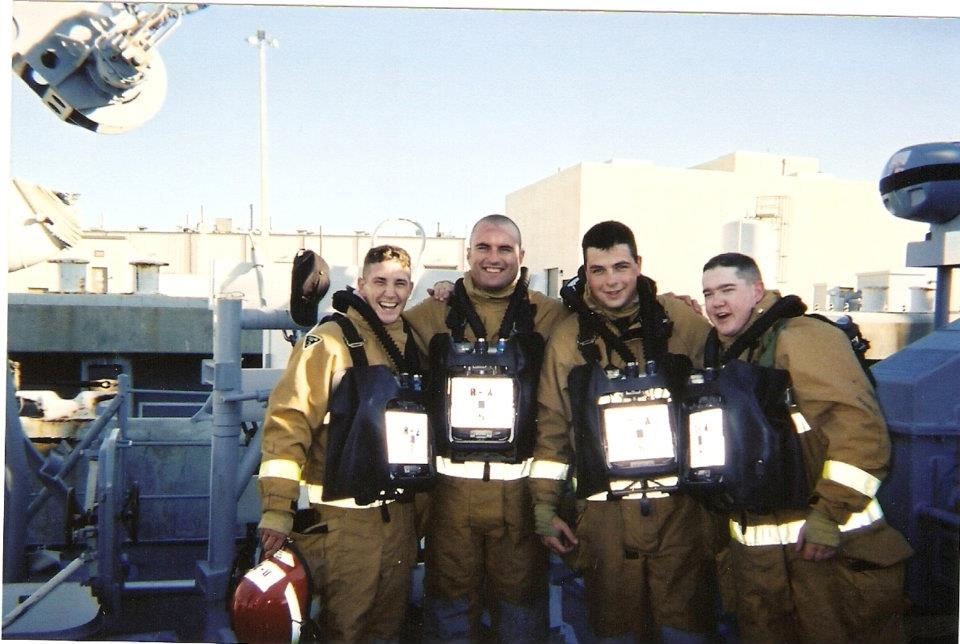
Why?
Because if you can’t align main drainage during an emergency, shore up a bulkhead, or identify a fire class and the right type of agent to put it out, you’re not helping the team — you’re endangering it.
The more qualified you were, the more you eased the burden on everyone else. Today, some sailors file grievances or sulk over this kind of treatment, but back then, it wasn’t hazing, it wasn't personal - it was survival. Those first three months of quals ensured that when the ship needed me, I could actually contribute.
Enough grandstanding. Let’s get to the fun part.
My First Minesweeping Evolution — or “We Do WHAT?”

My first sweep evolution was a simple maintenance check on our magnetic tail — a coaxial cable, copper‑cored and wrapped in buoyant plastic, that streamed nearly a mile behind the ship. It floats, not sinks, and its whole purpose is to create a magnetic signature in the water.
Remember: MCMs are wooden.
Why?
Because some mines detonate when a sufficiently strong magnetic field passes overhead.
So, MCM’s tow a fake magnetic signature behind it to make the mine believe a large vessel is passing over and then, Ka-Boom!

My first thought was:
“This is the same method we used in World War II, Korea, and Vietnam. Surely we’ve come up with something better.”
I was wrong. Dead wrong.
But I’ll tell you this — it was fun. We spent long, blistering days on the fantail conducting evolutions that would rival Deadliest Catch in the weather we had no business operating in.
Wooden Ships, Iron Men, and the Tightest Crews You’ll Ever Find
Those small ships were all I knew until I commissioned as a Chief Warrant Officer in 2015. I spent years at sea across the globe on multiple platforms of the same class, and the common thread across all of them was the same:
Tight crews. Bonds forged through shared pain and impossible tasks.

Some of the best Commanding Officers I ever served with were MCM sailors — men who later became Admirals and Captains with major commands. The Chiefs Mess? That was the first real one I experienced. They were seasoned, rough around the edges, and absolutely committed to their sailors. They’d chew you out one minute and wrap you in a hug the next while explaining exactly where you went wrong.
They were Iron Men on wooden ships, and they shaped the sailor — and leader — I became.
Cheetos, Red Gatorade, and the Aftermath
Within a few hours of leaving Ingleside, Texas, and heading into the Gulf of Mexico on my very first underway, I learned a hard truth: I did get seasick. I’d crushed a bag of Cheetos and washed it down with a red Gatorade because it was a warm spring day in South Texas. Terrible decision. What followed was a level of misery I did not see coming.
Minesweepers aren’t known for their gentle ride. They’re more like a cork in a bathtub—small, bouncy, and unforgiving. My Leading Petty Officer took one look at me turning green and said, “Go to the fantail, stick your finger down your throat, and get it over with. You’ll feel better.” So I did exactly that. And he was right… for about fifteen minutes.
It took me a full 24 hours to finally get my sea legs. After that, I learned a few simple rules:
• Be careful what you eat before getting underway
• And for the love of God, don’t be hungover
I’d learn that second lesson the hard way later that year, after a port visit in Panama City Beach.
Of course, I got ridiculed for hanging over the fantail and feeding the fish. What I eventually found out was that half the guys giving me grief were sick too—they were just hiding it better. I had zero shame and owned it.
I remember reporting to the bridge for my under‑instruction watch, still pale and shaky. The Commanding Officer looked at me and said he was worried I might fall overboard from how violently I’d been puking. He laughed, patted me on the back, and, before walking off, handed me a handful of saltine packets.
“You still showed up for your watch, and you’re doing your duty. Good start for your first underway.”
That little gesture stuck with me my entire career. Didn’t matter how you felt—show up, suck it up, because people were counting on you to relieve the watch.
Years later, as a Senior Chief Petty Officer, I was standing Officer of the Deck on the USS Chief, crossing the Sea of Japan in brutal seas. The only people still upright—well, sort of—were me, the poor helmsman with a trash bag tied to his belt, and maybe two engineers down in the plant. The CO was laid out in his cabin. The XO, who would later become the CO, was sitting proudly in the captain’s chair like he was daring the ocean to try him.

He’d say things to me that night with the calm, casual confidence of a man who had clearly made peace with dying at sea. Stuff like, “It’s quite sporty out there tonight,” as if we were discussing a mildly competitive game of pickleball and not the ocean actively trying to murder us.
Then he’d glance between the RADAR out the window, brace himself, and mutter, “Oh shit… this one’s gonna be big.”
Right on cue, a crest of a wave would rise up like Poseidon himself had a personal beef with our hull. It would smash into the superstructure so violently that the entire ship shuddered as if it had just been rear‑ended by a semi. White water swallowed us whole, pouring over the decks and windows like we’d just driven into a car wash run by angry gods.
Meanwhile, I’m standing there doing my best impression of “unfazed,” which in reality meant white‑knuckling our Oh‑Shit handlebars like they were the last two rungs on the ladder to heaven. My only real goal was to stay upright and not become an unscheduled projectile.
It was comical—two grown men pretending this was all totally normal—until we hit that moment. The one where the ship listed to port and just… stayed there. Way too long. Long enough for both of us to exchange that silent, wide‑eyed look sailors only use when they’re mentally reviewing their life insurance paperwork.
The XO didn’t raise his voice, didn’t panic, didn’t even spill his coffee. He just turned to the helmsman and me and said, with the calm of a man negotiating with fate,
“Let’s come a few more degrees to starboard and not test it tonight.”
At that exact moment, I was busy hauling the helmsman back to his feet because the poor guy had gone down like a folding chair at a family reunion. Once he was upright again and the ship finally rolled back to center, we all exhaled at the same time.
Five of us manned that ship for almost ten hours in 10–14-foot seas. It wasn’t my first time in weather like that, but it was the first time almost the entire crew was down for the count. And in that moment, my mind went straight back to those early days on my first ship—the hard‑nosed Chiefs, the Officers who didn’t sugarcoat anything, the lessons that were simple but unforgiving.
Suck it up. People are counting on you.
So that’s what we did. We held the line, kept the ship safe, and waited for the weather—and the crew—to rise again.
The Mail Buoy Watch and Ice Cream Party
There are things you see at sea that you can’t explain—strange lights in the water at night, a random wake in glass‑calm seas, the usual “what the hell was that?” moments. But the ones that stick with you are the moments when you’ve been underway for weeks, you finally get an hour of downtime, and chaos immediately follows. That’s when the Navy really shines.
Like every ship, we had our welcome‑aboard rituals for the new guy. I was lucky—I dodged most of the worst ones. But one underway period, we had a few hours before the next watch rotation, and boredom is a dangerous thing for a group of young sailors.
So naturally, we decided it was time to set the Mail Buoy Watch.
We got the new seaman fully kitted out like he was about to conduct a high‑risk boarding operation:
• Full safety harness
• Kapok life jacket
• Battle helmet
• Grappling hook
• Twelve‑foot boat hook
Then we told him the Captain was expecting a very important package from the mail buoy we were about to retrieve.
Back then, this kind of thing was considered harmless fun. Today, the entire chain of command would be fired before lunch.
We marched him up to the bridge, where the Captain was standing. The kid snapped a perfect salute and said, with absolute seriousness:
“Sir, respectfully request to set the Mail Buoy Watch.”
The bridge went dead silent. Nobody knew how the CO would react.
Without missing a beat, the Captain said,
“Set the watch. And you better not miss it—I’m expecting an important package.”
Game on.
We took the new guy to the forecastle and started coaching him like it was an Olympic event—how to throw the grappling hook, reel it in, and when to switch to the boat hook. We kept him at it for a good fifteen minutes. Our Deck Chief eventually showed up, probably because the CO called him for adult supervision… or because he wanted front‑row seats.
Then the Captain came over the 1MC, loud and dramatic:
“Damn it! You missed it!”
The kid panicked.
“TURN AROUND! TURN THE SHIP AROUND! I’ll get it, I promise!”
He was practically in tears, convinced he’d just ruined the Captain’s day.
A few minutes later, the CO came down, put a hand on his shoulder, and told him it was okay. He’d done his job. We all had a good laugh. Then the Captain handed him a command coin and said:
“Welcome aboard. You like ice cream?”
The kid nodded—“Yes, sir”—still shaken but relieved.
That evening, the Captain made an announcement over the 1MC:
“Ice cream will be served on the mess decks from eighteen-hundred to twenty-hundred, courtesy of the Chiefs Mess, in recognition of the Seaman who stood the Mail Buoy Watch.”
On a minesweeper—where frozen goods were basically gold—that was a big deal.
It’s one of those moments that stuck with me. Yeah, we hazed him a little, but the Captain turned it into something else entirely—a rite of passage handled with dignity, humor, and respect. He made that kid feel like part of the crew. Like one of the Warriors.
And he got ice cream out of it. Hard to beat that.
The Life Raft Incident: Or, How to Accidentally Launch a Gulf Coast Rescue Operation
Months later—now a few years into my tour on Warrior—I finally witnessed something I’d only ever heard about in sea stories. We were in the middle of workups before deployment, knocking out the usual mountain of planned maintenance. One of those tasks was servicing the hydrostatic releases on the life rafts.
(A hydrostatic release unit is a small, clever device that makes sure a life raft can break free and float to the surface if the ship sinks.)
Now, before anyone thinks we were reckless, there are safety measures for this kind of maintenance. Retaining poles. Safety lines. Procedures written in bold, underlined, all‑caps Navy English. You’d have to work pretty hard to screw it up.
Which brings me to our young undesignated seaman.
This kid… let’s just say he was strong. Very strong. But the Navy has a saying: you’re either smart or strong. He was not issued both.
We were about a hundred miles off the Redneck Riviera—the Florida panhandle—when it happened. While conducting maintenance on Life Raft #5, the raft went overboard.
And here’s the kicker:
No one saw it.
Not the aft lookout.
Not anyone on deck.
Just the sailor doing the maintenance.
And he didn’t say a word.
Instead, he walked straight to the Chiefs' Mess and stood there like a man waiting to be sentenced. He was trying to build up the courage to tell our Deck Chief—who, to put it politely, did not handle bad news well.
Next thing I know, I’m being summoned to the CPO Mess. As the Work Center Supervisor, I was responsible for assigning and managing the maintenance. The moment I appeared, Chief didn’t say a single word—just, “Follow me.”
That’s when I knew something catastrophic had happened.
We walked to the fantail. Chief pointed to the starboard side where Life Raft #5 should’ve been.
Gone.
I said, “Holy shit! Where did it go?”
Chief shot back, “Well, I can tell you it didn’t fly away. It went over the side, genius. And Seaman Dipshit over here apparently can’t read a maintenance card to save his life.”
Now, back then, I had a terrible habit of cracking jokes in tense moments. Most of the time, Chief loved it. Not that day.
I said, “Well, look on the bright side—we’ll finally know if these things actually work. Think of all the training we can do with an inflated life raft.”
Chief glared at me.
“Ramsey, if you don’t wipe that grin off your face, I’ll do it for you.”
I went stone‑cold silent.
After staring at the empty cradle for what felt like an hour, Chief finally said, “Well, fuck it. Twenty‑five years in the Navy and I’ve never seen this happen. Heard stories, but damn. Bad news doesn’t get better with time. I’ll go tell the Captain.”
Then he added, “But we’ve got bigger problems. We have no way to tell anyone we didn’t sink.”
That’s when I learned our entire communications suite was dead. All we had was a VHF radio and some portable HF green gear. We’d just had a brand‑new Iridium satellite phone installed—but the service wasn’t activated yet.
Perfect timing.
What Should Have Happened
When a life raft accidentally goes overboard:
• The hydrostatic release trips
• The raft floats free and inflates
• The EPIRB activates and sends a distress signal to the Cospas‑Sarsat network
• Coast Guard, Air Force, and nearby vessels get the alert
• The ship reports the accidental release and begins recovery
What actually happened:
• The raft inflated
• The EPIRB activated
• We had no comms
• No one could reach us
• Ships and aircraft were diverted
• A Coast Guard plane eventually found us and asked why we were ignoring the world
Classic minesweeper operations.
We spent hours searching before finally spotting the raft. We recovered it—no photos, of course. Back then, nobody had cell phone cameras, and you didn’t want to be the sailor caught documenting this circus.
It was embarrassing for the Captain, for the crew, and especially for us—Battle “E” winners who suddenly looked like amateurs. We didn’t get the Battle “E” that year (Battle Efficiency Award). We did get it the next two years, though.
What is the Battle "E"? Very basics... A command earns the Battle Efficiency Award by excelling in:
• Ship handling / tactical performance
• Weapons employment
• Combat systems readiness
• Engineering and propulsion performance
• Training effectiveness
• Ability to execute mission objectives under stress
Only one unit per squadron gets it each cycle. That exclusivity is why it carries so much weight.
Turning a Mishap Into a Lesson
We ended up craning it back in the water the next morning. And by mid‑morning, the Captain—probably through my Chief—decided it was hot, morale was low, and we might as well make the best of it.

So what do Minesweeper sailors do with an inflated life raft? We hold a swim call and full abandon‑ship training. Hours of sailors jumping in, swimming around, and climbing into the raft. It turned out to be one of the best training days we've ever had.
I stood next to Chief on the fantail, watching everyone splash around. I said, “See, Chief? It all worked out. Look how much fun they’re having.”
He sipped from his stained white coffee mug and said, “Shut up, Ramsey. Fun? This is the Navy life. You take shitty moments and mishaps, and you learn not to repeat them. Fun? You haven’t seen fun yet. From now on, you supervise every maintenance task with more than one warning or caution until you leave this ship—or replace me.”
Inside, I thought, This is going to suck.
Out loud, I said, “Aye, aye, Chief.”
The Aftermath
Chief surprised all of us. He didn’t explode. He didn’t throw anyone overboard. He owned the mishap. None of us know what happened behind closed doors with the Captain, but Chief walked out the same steady leader he’d been the day before.
He stood up for that young sailor at Captain’s Mast, took responsibility for the lack of training, and recommended a suspended bust with a mountain of Extra Military Instruction. (Basically, a slap on the hand.)
That sailor turned himself around. Before leaving Warrior, he earned the rank of Petty Officer Second Class and was named Junior Sailor of the Year.
Chief once asked me, “How many times do you show a sailor how to do something?”
I said, “I don’t know… three times?”
He shook his head.
“No, dummy. You show them until they get it right.”
Another lesson from the Chiefs Mess that stuck with me forever.
Closing: “Why These Stories Matter”
When I look back on all of it — the Cheetos and red Gatorade, the mail buoy watch, the life raft incident that nearly triggered a Gulf Coast rescue operation, the comms failures, the storms, the Chiefs who saved us from ourselves, and the young sailors who grew into leaders — I realize something I never understood at the time.
Minesweepers aren’t glamorous. They’re not fast. They’re not pretty. They don’t get the headlines. But they’re the ships that show you exactly who you are when the ocean, the mission, and the moment don’t care how ready you feel.
And now, with only four left in the fleet — after the four in Bahrain were heavy‑lifted out last year for scrapping — it hits a little harder. It’s bittersweet. Those little wooden beasts shaped generations of sailors. I always called them “Navy appreciation ships” because after one tour on an MCM, every ship you step on afterward feels like a luxury cruise.
Out there, especially in places like the Strait of Hormuz or off the coast of Japan — then and now — you learn quickly that nobody is coming to save you. You rely on your training, your shipmates, and the stubborn belief that you’ll figure it out because you have to. And somehow, you always do.
The funny stories matter because they remind us we were human.
The hard stories matter because they remind us that we were capable.
And the leadership moments matter because they remind us we were never alone.
My first ship wasn’t the biggest or the fastest.
But I served on the one that taught me the most.
And if the world is paying attention to minesweepers again — good.
Because the truth is, the smallest ships often carry the biggest responsibilities.
They always have.
These stories aren’t just sea stories.
They’re reminders of what it means to show up, suck it up, and stand the watch — even when the seas are rough, the comms are dead, and the life raft is drifting somewhere off the panhandle.
If you’ve ever served on one of these little wooden beasts, you already know:
You don’t forget the ride.
You don’t forget the people.
And you sure as hell don’t forget the lessons.
Warrior by name. Warriors by necessity.


